Simplifying DevOps

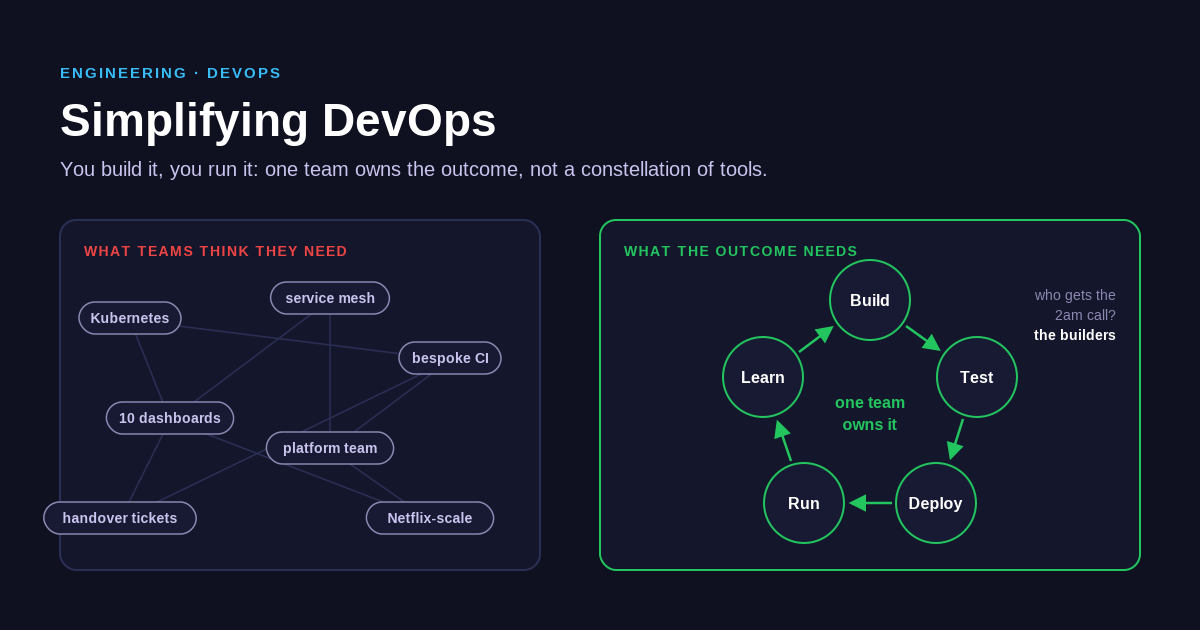
The Origins of DevOps
DevOps is often talked about as a methodology, a toolset, or a team structure. In practice for Manufacturing, Supermarkets, Banking, Education, HealthTech, FinTech and Tax Returns, it is more usefully understood as an accountability shift.
The term came from a simple idea: You build it, you run it — Werner Vogels [1]. That origin matters because it reframes the problem from “who is responsible for handover” to “who is responsible for outcome”. In a factory line, a bank core, or a tax returns portal, the consequence of that shift is not cultural decoration; it is who gets called at 2am when a batch job fails during payroll week or tax filing deadline.
For these sectors the subject means the same thing everywhere: aligning the people who change software with the people who live with those changes. The constraints differ — regulated audit trails in Banking and HealthTech, uptime windows in Supermarkets, seasonal spikes in Tax Returns — but the core principle does not need sector vocabulary to travel.
Common Misconceptions
The most damaging misconception is that DevOps equals complexity. Teams in the industries above often assume they need a large platform team, bespoke pipelines, and a constellation of tools before they can “do DevOps”.
This trend is reinforced by Kubernetes and the fact that everyone thinks they need the same architecture as Netflix, Twitter, … In the end, people end up with a very complex setup to handle the load a simple $50 hosting package from the 90s could have done. [1]
A second misconception is that automation, monitoring, and continuous integration are prerequisites that must be built in-house. In reality they are means, not ends. The question is not whether you automate, but what you automate first given your risk profile and team size. For a small Education platform or a regional Supermarket chain, a heavier platform can create more toil than it removes.
A third misconception is that DevOps requires a DevOps department. The origin idea of “you build it, you run it” pushes ownership back to development teams. That works best when the deployment path is simple enough that developers can use it safely without a dedicated release team.
Simplifying Deployment
Simplifying deployment is the highest leverage step for most organisations in the listed sectors. The goal is not minimalism for its own sake; it is reducing the number of manual steps between a tested change and a safe production release.
For small companies, try to find a platform (Heroku, Render, …) your developers can use to deploy their application themselves. [1]
That guidance is not limited to startups. Even in regulated domains like Banking, HealthTech, and Tax Returns, using a managed platform for non-critical workloads can free engineering capacity for compliance-heavy systems that genuinely need custom control.
When comparing deployment approaches, the trade-off is rarely about features alone.
| Approach | Typical components to manage | Deployment speed perception | Team ownership |
|---|---|---|---|
| Managed platform | Platform | Minutes | Developers |
| Self-managed Kubernetes | Cluster, networking, storage, observability | Hours to days | Platform + Developers |
| Complex bespoke architecture | Many custom services | Days to weeks | Multiple teams |
The diagram below shows a simplified release decision flow that many teams in Manufacturing and Supermarkets find useful.
Simplifying does not mean ignoring constraints. In HealthTech you still need audit logs. In FinTech you still need segregation of duties. The simplification is about removing unnecessary architectural replication rather than removing controls.
The Role of Automation
Automation is frequently presented as an all-or-nothing goal. A more practical view is to automate the most repetitive, error-prone steps first.
In the target sectors, the consequence of manual steps shows up clearly: a delayed price update in Supermarkets, a missed batch in Manufacturing, a late tax calculation in Tax Returns. Automation’s value is in consistency and speed of feedback, not in replacing human judgment.
Where automation helps most is in making the path from commit to verifiable change boring and repeatable. Teams often find it useful to start with deployment automation, then add guardrails for rollback, and only later expand to broader workflows.
A useful way to think about automation maturity is as a table rather than a checklist.
| Level | What is automated | Typical outcome |
|---|---|---|
| Manual | None | Slow, error prone |
| Deploy automation | Build and release steps | Faster releases |
| CI basics | Tests on change | Earlier feedback |
| Feedback loops | Monitoring to deploy | Safer changes |
Opinion, not fact, is that many teams in Education and HealthTech over-invest in automation before they have simplified their architecture. The simpler the target, the easier automation becomes.
Monitoring and Continuous Integration
Monitoring and continuous integration are often discussed together because they close the loop between change and consequence. The common misconception is that more dashboards equal more visibility.
In practice, effective monitoring for Manufacturing, Banking, and HealthTech means choosing signals that map to business impact. The subject means the same everywhere: observe outcomes, not just infrastructure.
Continuous integration is commonly misunderstood as “run all tests on every commit”. The practical guidance is to keep the feedback loop short enough that developers stay engaged.
A lifecycle view can help teams align these practices:
The key decision for these industries is where to invest first. Teams with limited platform capacity often benefit more from a reliable, simple deployment path with basic monitoring than from a sophisticated CI pipeline that runs on a fragile, complex stack.
DevOps, when simplified, is not about adopting every tool. It is about reducing the distance between building and running, choosing platforms that let developers ship safely, and avoiding unnecessary architectural complexity that does not match actual load or regulatory need.
References
- The Big DevOps Misunderstanding — wolfoliver.medium.com