Secure AI Execution with Agent Compute Engine

What is Agent Compute Engine?
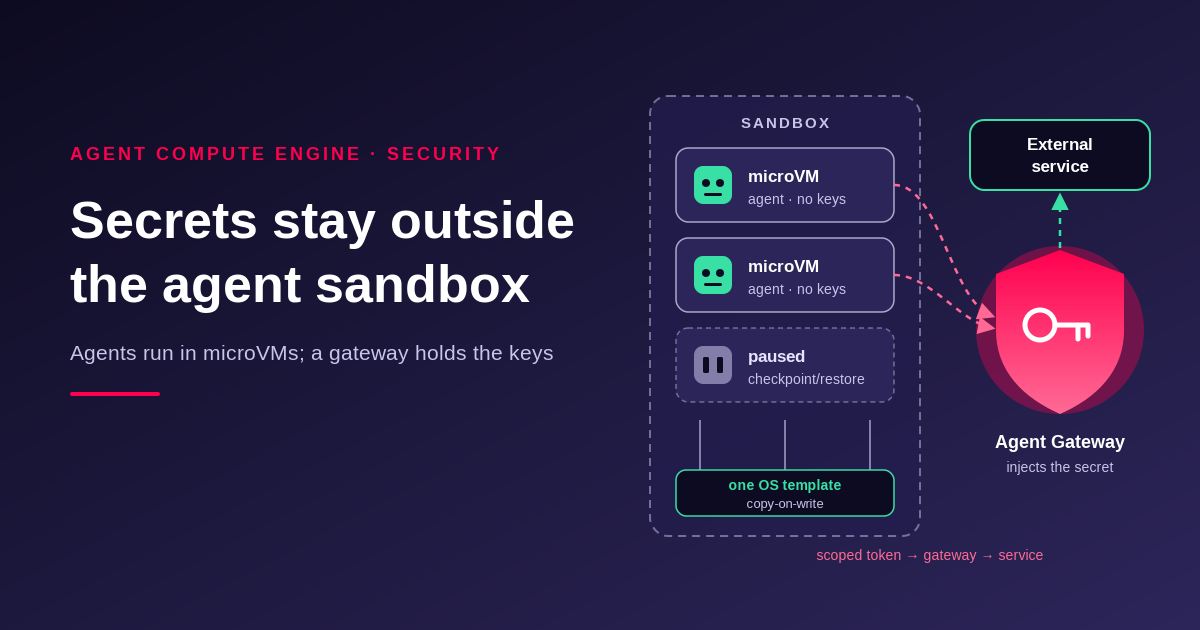
Agent Compute Engine achieves this by using copy-on-write memory sharing to run multiple agents on a single operating system template, and pausing idle microVMs via fast checkpoint and restore [1].
The architecture supports four main workload categories [1].
Agent Compute Engine is not yet available, and pricing has not been announced. The cloud provider is targeting a preview in the coming months [1].
The engine is positioned as a runtime layer for agent workloads rather than a general-purpose compute service. The single OS template model means a base image is loaded once and then forked per agent via copy-on-write, so memory pages are shared until an agent writes to them. Pausing idle microVMs via fast checkpoint and restore allows the fleet to shrink its active memory footprint when agents are bursty.
Benefits of Using Agent Compute Engine
Density and cost efficiency. Copy-on-write memory sharing lets many agents share one OS template, reducing memory overhead per agent [1]. Idle microVMs can be paused and restored quickly, which matters when agents run intermittently.
In practice this changes the economics of per-request agents. A full VM per agent keeps the entire memory image resident even when the agent is waiting for input. With copy-on-write plus checkpoint/restore, the cold set can be offloaded and rehydrated when the next task arrives. For workloads with long idle periods, the pause/resume cycle is the primary lever for density.
Consistent sandboxing. The runtime provides lightweight, sandboxed execution environments [1]. Developers can deploy the same agent pattern across use cases without re-engineering isolation.
The sandbox is a microVM, not a container. That gives stronger isolation boundaries for untrusted code generation and web browsing while remaining lighter than a full VM. The same isolation primitive is reused for interactive agents, persistent workspaces, parallel evaluation, and lightweight sandboxed execution.
Developer speed. Because the engine supports persistent Linux workspaces for autonomous software engineering and large-scale parallel environments for evaluation [1], teams can test, iterate, and roll out agents with less operational scaffolding.
Persistent workspaces keep state across runs for software engineering agents that need a file system and tool chain. Parallel environments allow the same agent logic to be fan-out tested against many inputs for model evaluation and reinforcement learning. Both are served by the same copy-on-write template and checkpoint mechanism.
A simple comparison of execution models helps frame the choice:
| Model | Isolation | Startup latency | Typical use |
|---|---|---|---|
| Full VM per agent | Strong | High | Long-running, stateful workspaces |
| Agent Compute Engine microVM with copy-on-write | Strong | Low | Bursty interactive agents, sandboxed tasks |
| Shared process | Weak | Very low | Trusted internal scripts only |
Secure AI Agent Execution with Agent Compute Engine
Security for AI agents means two things in practice: limiting what the agent can access inside its runtime, and protecting secrets it needs to call external services.
Agent Compute Engine keeps credentials, API keys, and OAuth refresh tokens outside the agent sandbox, using an external Agent Gateway to authenticate requests and inject the required secrets [1]. The agent never sees long-lived secrets in its memory space; the gateway mediates every outbound call.
The execution flow can be summarized as:
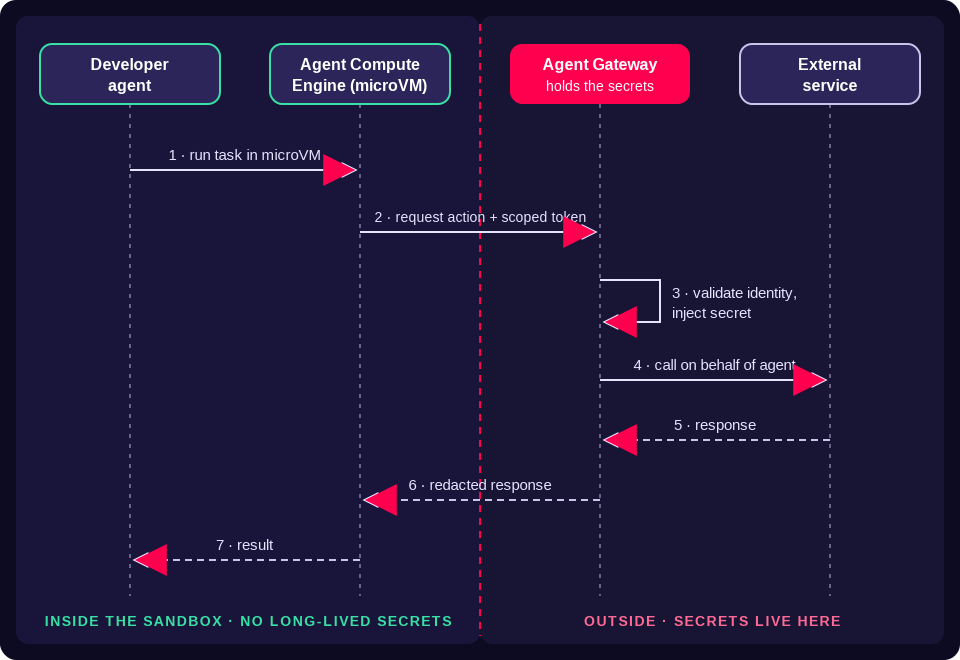
This model reduces blast radius. If an agent is compromised, the attacker does not gain persistent credentials.
A minimal developer configuration sketch shows how the gateway boundary is expressed:
agent_runtime:
  engine: agent_compute_engine
  template: linux-base-v1
  isolation: microvm
  memory_share: copy_on_write

gateway:
  secret_store: external
  allowed_scopes:
  - inventory.read
  - pricing.write
  inject_secrets: true
The important point for regulated sectors is that the separation of secrets from the sandbox is architectural, not policy-based. Teams can map it to existing controls around key management without inventing new audit trails.
The gateway also provides a single enforcement point for outbound traffic. Because every external call is routed through the Agent Gateway, the agent’s request can be validated, scoped, and logged before a secret is injected. Responses can be redacted before they return to the microVM, limiting data leakage from the service back into the agent’s memory.
From an engineering standpoint, the configuration surface is small. The runtime declares the template and isolation mode; the gateway declares the secret store and allowed scopes. There is no secret material in the agent image or environment variables. When an agent is paused via fast checkpoint and restore, the checkpoint contains no long-lived credentials because they were never inside the sandbox to begin with.
Industry Applications and Examples
The engine's four workload categories map broadly across industries. The technical mechanism is the same everywhere: isolated execution with external secret management. The consequences differ by sector.
Manufacturing: Agents can run predictive maintenance scripts on sensor data using large-scale parallel environments for model evaluation and reinforcement learning [1], letting teams test control policies safely before deployment to the plant floor. Copy-on-write memory sharing keeps the per-agent memory cost low when many simulations run in parallel, and pausing idle microVMs via fast checkpoint and restore [1] helps contain cost during off-shift periods.
Supermarkets: Interactive agents can browse web catalogs and update local inventory systems. Lightweight, sandboxed execution environments [1] let the same agent run per store without cross-contamination of data. The external Agent Gateway ensures that each store’s API keys and OAuth refresh tokens remain outside the agent sandbox [1], so a compromise in one store does not expose credentials for others.
Banking and FinTech: Persistent Linux workspaces for autonomous software engineering [1] enable agents to generate and test code against sandboxed ledgers. Credentials and API keys remain outside the sandbox via the external Agent Gateway [1], which is critical for payment APIs. The checkpoint/restore behavior is useful for compliance testing where agents must be stopped and resumed under audit.
Education: Consumer-facing tutoring agents can execute code within a per-student sandbox. The copy-on-write model [1] keeps per-student cost low while maintaining isolation. Because secrets are kept outside the sandbox, the gateway can enforce per-student scopes for content APIs without exposing master tokens to the agent.
HealthTech: Clinical decision-support agents can be run in lightweight sandboxed execution environments [1] with strict secret boundaries. Keeping OAuth refresh tokens outside the agent sandbox [1] helps meet expectations around access control. The microVM isolation provides a clean boundary for code execution from untrusted prompts.
Tax Returns: Seasonal spikes are handled by pausing idle microVMs via fast checkpoint and restore [1]. Agents can process forms and call tax APIs through the gateway, and shut down without leaking credentials between tenants. The same template can serve thousands of short-lived sessions, with memory sharing reducing the baseline footprint.
Across these sectors, the operational pattern is similar: collect input, run agent in isolated microVM, mediate external calls through gateway, return result. The difference is data sensitivity and uptime expectations, not the engine mechanics.
Migration from existing patterns tends to focus on two changes. First, moving from full VM per agent to microVM with copy-on-write changes how startup latency and memory are budgeted. Second, moving secrets into the external Agent Gateway changes how outbound calls are made. Code that previously read an API key from environment variables must instead request an action with a scoped token and let the gateway inject the secret. That is a developer-visible change, but it centralizes secret handling.
What to watch for is agent behavior that assumes persistent in-memory secrets or local state across restarts. Because idle microVMs can be paused and restored, any state that must survive a checkpoint should be written to external storage rather than kept only in process memory. The copy-on-write model also means the first write to a shared page triggers a copy; write-heavy agents will diverge from the template faster than read-heavy agents.
Conclusion
Agent Compute Engine offers developers a way to run many AI agents on a shared OS template with copy-on-write memory sharing and fast pause/resume [1], while keeping credentials, API keys, and OAuth refresh tokens outside the agent sandbox via an external Agent Gateway [1]. It supports interactive agents, persistent workspaces, parallel evaluation, and lightweight sandboxed execution [1].
For Manufacturing, Supermarkets, Banking, Education, HealthTech, FinTech and Tax Returns, the benefit is consistent: safer, denser agent execution without per-agent VM sprawl. The engine is not yet generally available and pricing has not been announced [1], so teams should plan for a preview window and validate their secret-management and audit requirements against the gateway model before adoption.