AI-Assisted Software Engineering

The Rise of AI-Assisted Software Engineering
AI-assisted software engineering is the practice of pairing engineers with models that generate code, specs and tests, while engineers retain ownership of intent, review and durability. Adoption is measurable: ML-based code completion has provided a major boost for software developers [1], and 44% of developers said that they use AI tools in their development process now, and 26% plan to soon [2]. Gartner predicts that 75% of enterprise software engineers will employ AI code assistants by 2028 [2].
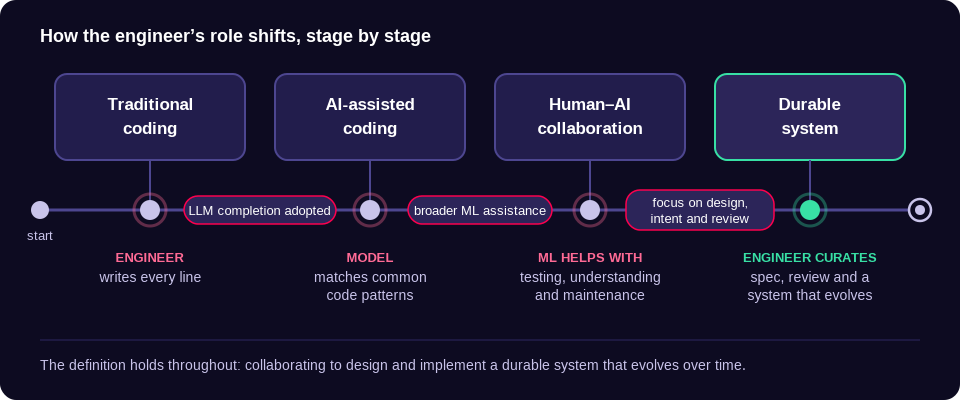
The initial wave was pattern matching. The patterns of code required for frontend, backend, and fullstack engineers have been successfully recognized by LLMs [3]. In practice this means a single staff engineer with experience and a trusty LLM is similarly productive as a team of 2-4 junior engineers led by a senior engineer was only a short 5 years ago [3].
Human-computer interaction has moved towards natural language as a common modality, and we are seeing a shift towards using language as the interface to software engineering tasks as well as the gateway to informational needs for software developers, all integrated in IDEs [1]. Tools such as Copilot Workspace execute requests systematically step by step, creating a specification, generating a plan, and then implementing that plan [2]. Given a GitHub repo or a specific bug within a repo, Workspace — underpinned by OpenAI’s GPT-4 Turbo model — can build a plan to attempt to squash the bug or implement a new feature, drawing on an understanding of the repo's comments, issue replies, and larger codebase [2].
The next wave is broader. We expect the next wave of benefits to come from ML assistance in a broader range of software engineering activities, such as testing, code understanding and code maintenance; the latter being of particular interest in enterprise settings [1]. ML-based automation of larger-scale tasks — from diagnosis of an issue to landing a fix — has begun to show initial evidence of feasibility [1].
The rise is uneven. Coding LLMs are always going to be better at things well-represented in their training sets. Which is to say, the most popular languages, API styles, apps as of todayish [3]. For teams in Banking, Education, HealthTech, FinTech and Tax Returns this matters: compliance-heavy, regulated codebases with long-lived domains tend to be less represented in public training data than greenfield web apps.
Impact on Software Engineers
Software engineering is the act of collaborating with others to design and implement a durable system that evolves over time [4]. That definition does not change, but the division of labor inside it does.
AI shifts engineers from boilerplate production to stewardship. Build-time agents can provide significant increases in end-to-end delivery by replacing manual delivery with AI generated product and engineering specs, code, and tests written by build-time agents [5]. Run-time agents can provide solutions to problems that were previously unsolvable, such as dynamic customer service bots and real-time transcription and summarisation [5].
In conventional development, code is often regarded as the primary artifact. However, code frequently lacks the implicit context and developer intent that are essential for LLMs to effectively generate accurate and relevant modifications or extensions [6]. That gap explains why AI is strong at generating, but weak at safely changing, legacy systems in banking core, student information systems, or clinical workflows where implicit rules live in documentation, policy, and tribal knowledge.
Literate Development therefore posits that comprehensive documentation should serve as the central, authoritative source of information [6]. The practical implication is a reversal of the old habit of “code is truth”. When LLMs should not be used to simultaneously alter or produce all linked elements (code, documentation, and tests) at once [6], engineers become editors of an explicit contract rather than authors of every line.
A trade-off emerges between speed and determinism. Performant — Code is fast. No matter what we do, AI agents will always be slower to solve a deterministic problem than a coded algorithm [5]. For high-throughput transaction processing in FinTech and Tax Returns, that is a constraint, not a preference.
| Activity | AI strength today | Human value remains |
|---|---|---|
| Boilerplate generation | High; patterns recognized [3] | Review for correctness and context |
| Test generation | Growing; next wave benefit [1] | Design test strategy for edge cases |
| Code maintenance | Growing; next wave benefit [1] | Understand intent and business risk |
| Deterministic hot paths | Low; code is faster [5] | Write and optimize critical code |
Skills in Demand
The job market is moving from “can you code” to “can you direct, verify, and maintain”.
Prompting and task decomposition. Natural language is now an interface to software engineering tasks [1]. Engineers must frame problems so that step-by-step execution — specification, plan, implementation — succeeds.
Code review as risk review. With AI generating code and tests, review shifts to intent, security, and compliance. In Banking and HealthTech, this means verifying audit trails, data minimization, and regulatory constraints that are not visible in the code alone.
Documentation as source of truth. Because LLMs need context beyond code, the ability to write clear, comprehensive documentation becomes a force multiplier. Literate Development posits that comprehensive documentation should serve as the central, authoritative source of information [6].
Systems thinking and durability. Software engineering is the act of collaborating with others to design and implement a durable system that evolves over time [4]. AI accelerates throughput but does not replace architectural judgment.
Toolchain fluency. With Go, AI models can leverage the platform’s end-to-end toolchain to operate on Go code faster, cheaper, and more reliably, producing higher-quality, more secure, and more correct code [4]. The broader lesson is that language ecosystems with strong tooling amplify AI assistance.
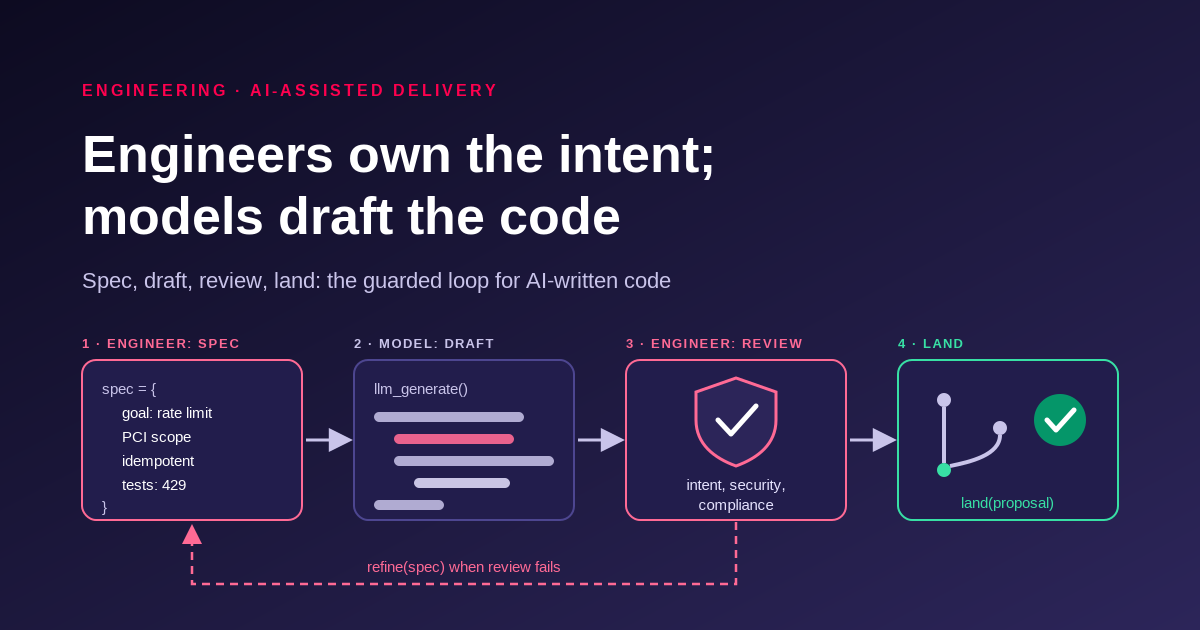
A minimal example of the guarded loop:
spec = {
  "goal": "Add rate limit to payment webhook",
  "constraints": ["PCI scope", "no DB schema change", "idempotent"],
  "tests": ["429 on burst", "passes audit log"]
}

proposal = llm_generate(spec, repo_context)

def review(proposal, constraints):
  # human checks intent, security, regulatory fit
  return True

if review(proposal, spec["constraints"]):
  land(proposal)
else:
  refine(spec)
The engineer owns spec and review; the model owns drafting.
Industry-Specific Implications
For Banking, Education, HealthTech, FinTech and Tax Returns the change is broadly similar, with sector-specific constraints that shape how assistance is used.
Regulation and auditability dominate Banking and FinTech. Build-time agents can generate specs and code, but sign-off, explainability, and change control remain human. AI assistance is most valuable for accelerating internal tooling and documentation, not for unsupervised production changes.
HealthTech adds clinical safety and privacy. Run-time agents can provide solutions to problems that were previously unsolvable, such as dynamic customer service bots and real-time transcription and summarisation [5], but the same capabilities require strict data governance. Human engineers remain essential for mapping clinical intent to safe software behavior.
Education and Tax Returns are documentation heavy. Systems evolve slowly and must be explainable to non-technical stakeholders. Literate Development’s emphasis on comprehensive documentation as the central source of information aligns directly with these domains, where policy changes drive code changes.
Where the subject genuinely applies the same way everywhere is in the core shift: from writing every line to curating durable systems. LLMs are better at tasks well-represented in their training sets, but human time is still valuable for tasks that are not [3]. In all five sectors, bespoke business rules, legacy integrations, and regulatory nuance are under-represented in training data, preserving human value.
Implementation Roadmap and Risks
Implementation begins with constraints, not prompts. First, define acceptance criteria and non-functional requirements in explicit specs. Second, integrate AI into the existing toolchain where tooling is strong; AI models can leverage the platform’s end-to-end toolchain to operate on Go code faster, cheaper, and more reliably [4]. Third, enforce a human-in-the-loop review gate before land, and prohibit simultaneous alteration of code, documentation, and tests by the same model run [6].
Risks include hallucinated APIs, loss of intent in legacy systems, and over-reliance on well-represented patterns. Code frequently lacks the implicit context and developer intent that are essential for LLMs to effectively generate accurate and relevant modifications or extensions [6]. AI agents will always be slower to solve a deterministic problem than a coded algorithm [5], creating latency and cost risks for hot paths. Human-computer interaction has moved towards natural language as a common modality [1], but natural language specs can be ambiguous without disciplined decomposition.
Conclusion
AI-assisted software engineering does not replace engineers; it redefines their leverage. Productivity rises when engineers pair pattern-recognition models with durable system design, explicit documentation, and disciplined review.
The next decade will reward engineers who can collaborate with AI as a teammate: defining intent clearly, verifying outputs rigorously, and maintaining systems that evolve safely under regulation. For Banking, Education, HealthTech, FinTech and Tax Returns, that means faster delivery of non-core work and tighter human control over core, risk-bearing decisions.
References
-
AI in software engineering at Google: Progress and the path ahead — research.google (6 June 2024)
-
Copilot Workspace is GitHub’s take on AI-powered software engineering — techcrunch.com (29 April 2024)
-
Ask HN: What will tech employment look like in 10 years? — news.ycombinator.com
-
[Why Go is an Ideal Language for AI-Assisted Software Engineering
- Google Developers Blog](https://developers.googleblog.com/why-go-is-an-ideal-language-for-ai-assisted-software-engineering/) — developers.googleblog.com (11 August 2026) -
The Evolution of AI Software Engineering — medium.com (23 August 2025)
-
Literate Development: AI-Enhanced Software Engineering — substack.com (30 March 2025)