Shared GPU Access on AWS
Shared GPU access lets organizations running personal AI workloads on AWS provide accelerated compute to developers and end users. For teams in manufacturing, supermarkets, banking, education, healthtech, fintech and tax returns, the pattern matters because workloads are often sporadic, data is sensitive, and compliance teams want a clear trust boundary between the operator and the user.
Technical Details of virtio-nvgpu
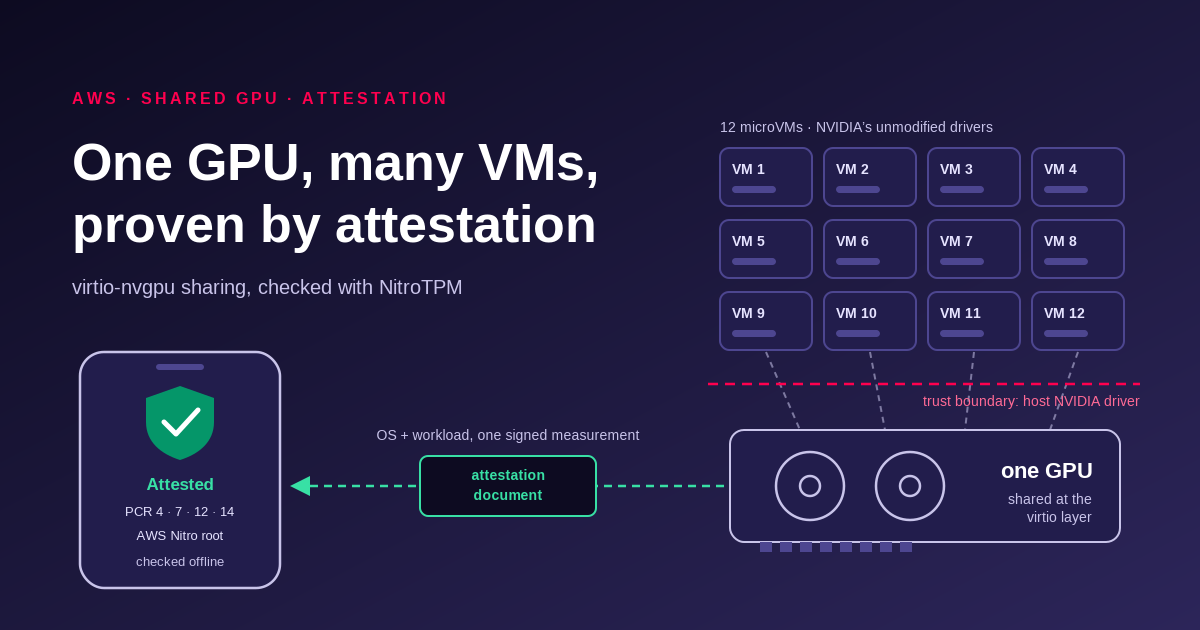
virtio-nvgpu is presented as a way to share one NVIDIA GPU across several VMs at bare-metal speed [1]. The key claim is that you can run NVIDIA's own unmodified drivers (Vulkan, NVENC, and CUDA) inside multiple microVMs without vGPU licenses or VFIO passthrough [1].
A published test notes that on an RTX 3060, 12 VMs can be run on one card, each encoding 720p60 H.264 with no dropped frames [1]. The project notes that it isn't hardware isolation. The host NVIDIA driver is the trust boundary. If tenants don't trust each other, use passthrough or vGPU [1].
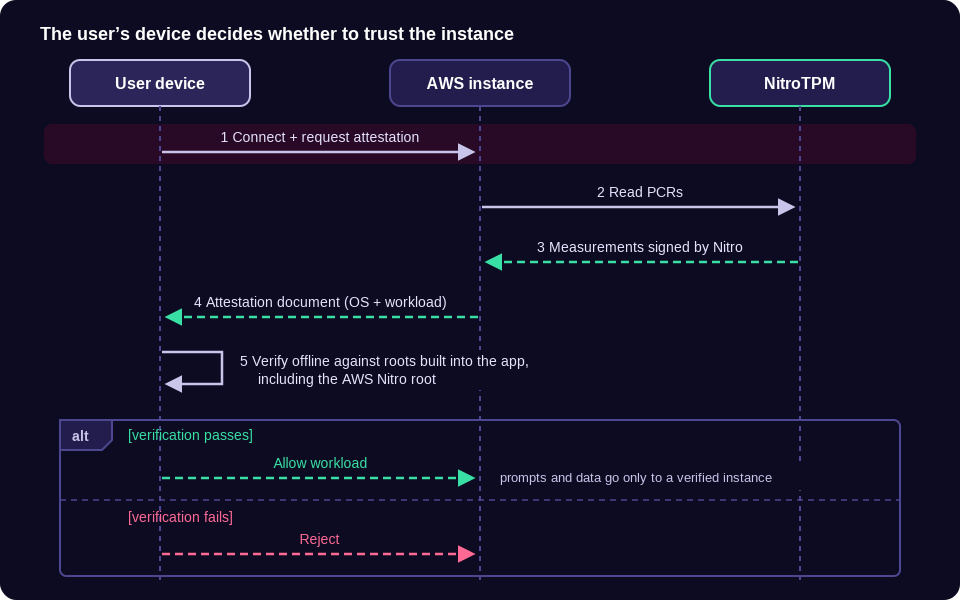
The pattern fits the Zero Operator Access model used by Bee on AWS. At runtime, the bootloader and operating system measure the boot components and extend those measurements into NitroTPM PCRs [2]. The attestation document that Bee's application servers present to clients reflects both the OS state and the workload state as a single signed hardware measurement [2]. The user's device decides whether to trust the instance by checking the embedded evidence offline against roots built into the app, including the AWS Nitro root [2].
Sharing at the virtio layer means the host keeps the physical device and multiplexes access to guest drivers. Because NVIDIA's own unmodified drivers can run inside multiple microVMs without vGPU licenses or VFIO passthrough [1], developer onboarding stays close to a standard CUDA environment. The operational gain is utilization. Sporadic personal AI use in education, retail and professional services leaves GPUs idle; pooling those slots onto one card raises effective throughput without provisioning dedicated instances per user.
The attestation chain complements the sharing layer. At runtime, the bootloader and operating system measure the boot components and extend those measurements into NitroTPM PCRs [2]. The resulting document therefore reflects both the OS state and the workload state as a single signed hardware measurement [2]. Verification happens on the client side. The user's device decides whether to trust the instance by checking the embedded evidence offline against roots built into the app, including the AWS Nitro root [2]. That design removes operator visibility as a trust assumption.
Trust Boundary and Security Considerations
For manufacturing and healthtech teams handling regulated data, the trust boundary definition is the central question.
With virtio-nvgpu the host NVIDIA driver is the trust boundary, and if tenants don't trust each other, passthrough or vGPU should be used instead [1]. That means a compromised host driver or a bug in the sharing layer can affect all tenants on the card. For internal personal AI where the operator is trusted but must not see user prompts or model outputs, the boundary is acceptable. For multi-customer SaaS in banking or fintech, it is not.
Zero Operator Access adds a second layer. Because the attestation document that Bee's application servers present to clients reflects both the OS state and the workload state as a single signed hardware measurement [2], the user's device decides whether to trust the instance by checking the embedded evidence offline against roots built into the app, including the AWS Nitro root [2]. This removes the need to trust the operator to have configured the instance correctly, because the measurement chain is anchored in NitroTPM.
The operational implication is a split of responsibility. The operator maintains the host and the sharing infrastructure. The user maintains the verification roots and the decision to send data. In education and tax returns where data minimization is critical, that separation is often a compliance requirement.
In practice the split creates concrete watch items. The host NVIDIA driver is the trust boundary [1]. If tenants don't trust each other, passthrough or vGPU should be used instead [1]. That constraint is stable across sectors. Manufacturing lines using personal AI for defect classification and supermarkets running price-optimisation models can accept a trusted operator boundary. Banking and fintech with external users generally cannot.
Attestation does not create isolation; it creates verifiability. The user can confirm the OS and workload measurements are those expected, and that the instance has not been tampered with by the operator. If the sharing layer is compromised, attestation will still verify the compromised state unless PCRs are updated to capture the sharing software. Teams must decide which components to measure into PCR4, PCR7, PCR12 and workload PCR14, and freeze the software stack that is measured.
Migration to this model involves two parallel tracks. Infrastructure must support Nitro Enclaves or NitroTPM attestation and a microVM supervisor capable of virtio-nvgpu multiplexing. Client applications must embed the AWS Nitro root and the expected PCR values, and implement offline verification before transmitting prompts or model weights. For personal AI, the workload image is often small and static, which simplifies the measurement set. For more dynamic workloads the measurement maintenance cost rises.
Operational maintenance remains. Even on cloud, firmware and OS drift affect the measurement chain. As a reference for personal AI hardware maintenance, upgrading firmware via CLI involves upgrading both the Ubuntu distribution as well as the firmware:
sudo apt update
sudo apt dist-upgrade
sudo fwupdmgr refresh
sudo fwupdmgr upgrade
sudo reboot
The commands illustrate the type of host-level changes that invalidate existing PCR baselines and require re-attestation. The same discipline applies to AWS hosts running the sharing layer.
Conclusion: Implementing Zero Operator Access on AWS
Implementing Zero Operator Access for personal AI on AWS combines shared GPU access with hardware attestation. Sharing one NVIDIA GPU across several VMs at bare-metal speed [1] reduces cost and improves utilization for sporadic workloads common in education, retail and professional services. Running NVIDIA's own unmodified drivers inside multiple microVMs without vGPU licenses or VFIO passthrough [1] simplifies developer onboarding.
The trade-off is isolation. The host NVIDIA driver is the trust boundary [1]. If tenants don't trust each other, passthrough or vGPU should be used instead [1]. For personal AI where the goal is to prevent operator access to user data, the combination of virtio-nvgpu style sharing and NitroTPM attestation gives a practical path: at runtime, the bootloader and operating system measure the boot components and extend those measurements into NitroTPM PCRs [2], and the user's device decides whether to trust the instance by checking the embedded evidence offline against roots built into the app, including the AWS Nitro root [2].
If you need to prove to users that the operator cannot see their prompts, attested shared GPUs deliver that with measurable hardware roots. If you need hardware isolation between untrusted tenants, shared GPU is the wrong tool.
References
- nestrilabs/virtio-nvgpu — github.com (17 November 2026)
- How Bee implemented Zero Operator Access for personal AI on AWS | Amazon Web Services — aws.amazon.com