AI Factories Shift Focus from Hype to Practicality

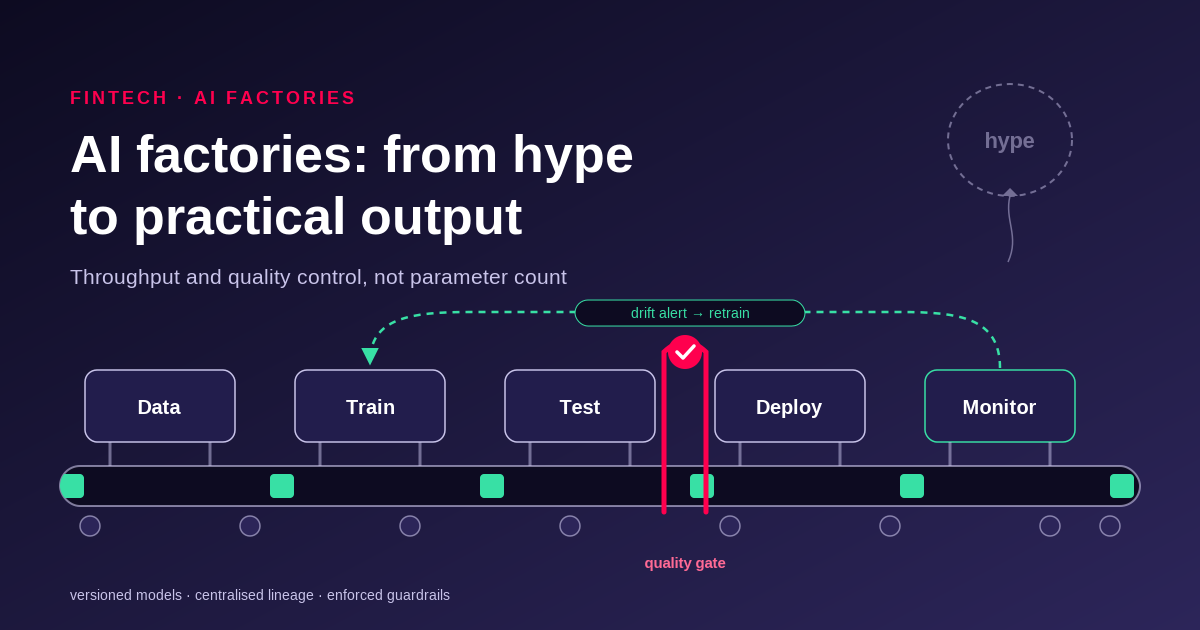
The conversation around AI is moving away from model size and toward measurable business outcomes. For FinTech developers, that shift matters because financial services demand reliable automation, auditable risk decisions, and customer trust at scale. AI Factories — organized pipelines that turn data and models into production products — are the operating model for making that practical.
An AI Factory is less a single model and more an engineering system: data ingestion, model training and tuning, testing, deployment, and continuous monitoring treated as a repeatable manufacturing line. The thesis is straightforward: in regulated FinTech, value is created by throughput and quality control, not by parameter count. That requires a factory mindset of versioned models, centralized lineage, and enforceable guardrails.
The Rise of AI Factories in FinTech
An AI Factory is an operating model: data ingestion, model training and tuning, testing, deployment, and continuous monitoring as a repeatable manufacturing line. In FinTech, the promise is to standardize how models move from experiment to regulated production.
The industry mood has turned pragmatic. The leaders of two of China’s biggest tech giants have urged the industry to focus on building practical applications [1]. That sentiment echoes a broader view that Practical applications, not more powerful models, will determine AI’s value [1].
Market context reinforces the pivot. There are concerns of an AI bubble and market jitters following the resignation of Nvidia CEO Jensen Huang [1]. For banks and payment firms, which operate under capital and compliance constraints, the implication is clear: invest where models reduce cost, risk, or friction, not where they generate headlines.
In FinTech specifically, the AI Factory pattern means:
- Automating high-volume financial transactions with consistent rules and fallback paths
- Improving risk assessment by combining structured transaction data with contextual signals in repeatable pipelines
- Enhancing customer experience through personalized assistance and faster onboarding, while keeping audit trails
The subject applies the same way across manufacturing, supermarkets, banking, education, HealthTech, FinTech and tax returns in one sense: the factory metaphor is about throughput and quality control. It differs in constraints. FinTech adds regulatory reporting, explainability, and zero-tolerance for silent failures.
Benefits and Challenges of Implementing AI Factories
Benefits are operational and measurable. A factory approach reduces duplication between research and production, shortens time to value for features like fraud detection, and creates a single place to enforce guardrails. For customer experience, models can be versioned and rolled back safely, which is essential when a chatbot gives financial advice.
Challenges are equally concrete. Data governance, model drift, and compliance auditing require dedicated ownership. A product that works in a lab can fail in production when it meets real-world data distributions and regulatory requirements.
The lifecycle can be visualized as a loop:
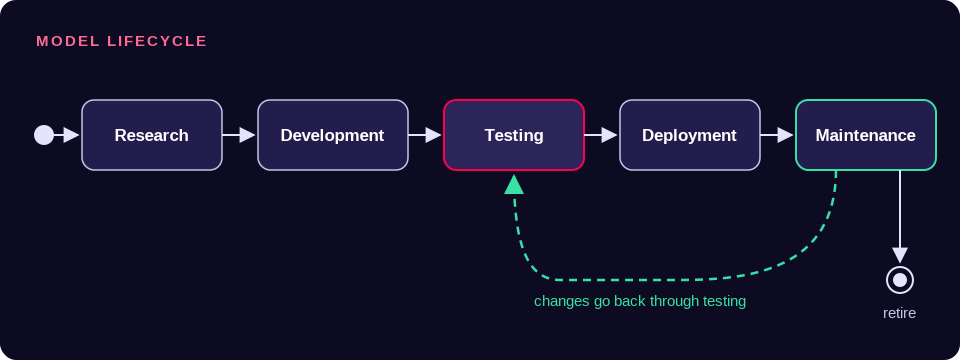
A practical view of trade-offs:
| Dimension | AI Factory Approach | Ad-hoc Model Deployment |
|---|---|---|
| Time to production | Faster after initial setup | Fast first, slow later |
| Auditability | Centralized lineage and logs | Fragmented |
| Risk control | Guardrails enforced in pipeline | Manual, inconsistent |
| Cost | High upfront, lower marginal | Low upfront, high technical debt |
Case Studies: Baidu, Xiaomi, and Google DeepMind
The sector-wide call for practicality is not abstract. The leaders of two of China’s biggest tech giants have urged the industry to focus on building practical applications [1]. The framing is explicit: Practical applications, not more powerful models, will determine AI’s value [1].
Google DeepMind provides a parallel signal from the research side. Google DeepMind has shifted from a research lab to an AI product factory [2]. The move reflects pressure to ship products, not papers.
That pressure also surfaces the risks of rushing. Google's AI Overviews feature began offering embarrassing suggestions, such as advising people to eat rocks and put glue on pizza [2]. The incident illustrates why FinTech teams care deeply about guardrails. A week later, Google's AI Overviews feature was updated in May 2024 to include new guardrails [2], describing them in part as a way to prevent Overviews from inadvertently presenting satirical content as fact.
For FinTech, the lesson is transferable: a factory without quality gates produces defective products at scale. In banking, a bad suggestion is not embarrassing; it is a compliance event.
Hardware narratives reinforce the practical turn. The NVIDIA DGX Spark is an ARM64 device with 128GB of memory that’s available to both the GPU and the 20 CPU cores at the same time, strapped onto a 4TB NVMe SSD [3]. NVIDIA DGX Spark is designed for AI developers, researchers, data scientists, and students who need powerful, always-on AI compute on the desktop—without relying on cloud or data center access for every workload [4].
The DGX Spark has a system memory of 64 GB LPDDR5X or 128 GB LPDDR5x, coherent unified system memory [4]. The DGX Spark has 128 GB of coherent unified system memory [5]. It has a 10 GbE RJ-45 Ethernet port [5] and two QSFP ports driven by NVIDIA ConnectX-7 NIC capable of up to 200 Gbps [5]. Up to 4 DGX Spark systems can be connected using NVIDIA ConnectX-7 networking [4].
These specs are cited not to endorse hardware, but to show how the factory story is increasingly about accessible, standardized compute that can sit behind a pipeline. The NVIDIA DGX Spark has extensive guides for getting things working, including a getting started guide, details on the DGX dashboard web app, and playbooks [3], and tools such as Claude Code can help with using the NVIDIA DGX Spark, including installing CUDA drivers and Docker incantations [3].
The DGX Spark can handle models with up to 405 billion parameters in FP4 [5]. The enterprise manageability features developed for DGX Spark 128 GB can also be applied to DGX Spark 64 GB [4], a reminder that manageability must be designed in from the start, not bolted on.
The Future of AI Factories in FinTech: Opportunities and Risks
Opportunities cluster around three uses requested by the brief: automate financial transactions, improve risk assessment, and enhance customer experience.
Automation can standardize reconciliation, payment routing, and back-office approvals, reducing manual error. Risk assessment benefits from continuous retraining on fresh data, with monitoring that flags drift before it harms decisions. Customer experience improves when assistants handle routine queries and onboarding flows, freeing human agents for complex cases.
Risks are systemic. Model errors propagate quickly in finance. Data privacy and regulatory reporting require immutable logs. The enterprise manageability features developed for DGX Spark 128 GB can also be applied to DGX Spark 64 GB [4], a reminder that manageability must be designed in from the start, not bolted on.
A minimal reference architecture for FinTech AI Factory:
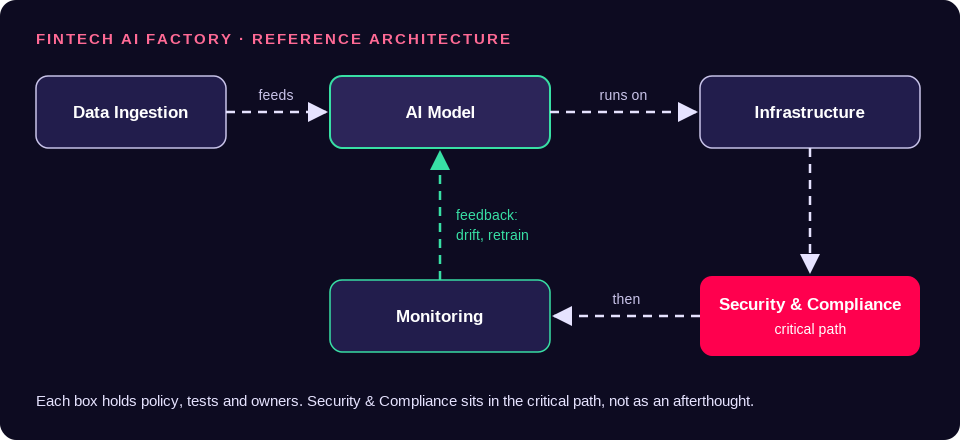
The diagram is deliberately simple. In practice, each box contains policy, tests, and owners. For FinTech, Security & Compliance sits in the critical path, not as an afterthought.
Conclusion: Navigating the AI Factory Landscape
AI Factories are not a new technology; they are a new discipline. The narrative has shifted from hype to practicality, driven by leaders urging practical applications and by market signals about an AI bubble [1]. The value of AI will be determined by its practical applications, not by the power of its models [1].
For developers in Banking, FinTech, and related regulated industries, the takeaway is operational. Build the pipeline first, then the models. Invest in testing, guardrails, and monitoring before scale. The case of DeepMind’s shift from research lab to AI product factory [2] and the public correction of AI Overviews [2] shows that even the best labs must manufacture quality.
In FinTech, that means factories that can automate transactions safely, assess risk transparently, and improve customer experience without sacrificing trust. The hardware, tools, and frameworks will evolve. The factory mindset — repeatable, auditable, and accountable — is what will endure.
Call to action: Audit your current model path from notebook to production. Map data ingestion, training, testing, deployment, and monitoring as a pipeline with owners. Add centralized lineage, versioned rollbacks, and drift alerts before the next model release. Start with one high-volume, low-risk workflow — e.g., reconciliation or KYC document classification — and measure time-to-production, audit coverage, and rollback success.
References
- Baidu, Xiaomi CEOs warn of growing gap between AI hype and returns — scmp.com
- Google DeepMind Shifts From Research Lab to AI Product Factory — bloomberg.com
- NVIDIA DGX Spark: great hardware, early days for the ecosystem — simonwillison.net (15 October 2025)
- Personal AI Supercomputer Powered by Blackwell | NVIDIA DGX Spark — nvidia.com (24 August 2025)
- NVIDIA DGX Spark In-Depth Review: A New Standard for Local AI Inference - LMSYS Org — lmsys.org (14 October 2025)