AI-Assisted Wikipedia Editing: A Double-Edged Sword

Wikipedia editing sits at the intersection of open knowledge and institutional trust. For teams in Banking, Education, HealthTech, FinTech and Tax Returns, the quality and verifiability of that knowledge matters directly: a clinician, compliance officer or tax professional who relies on a public reference needs accuracy, not speed alone.
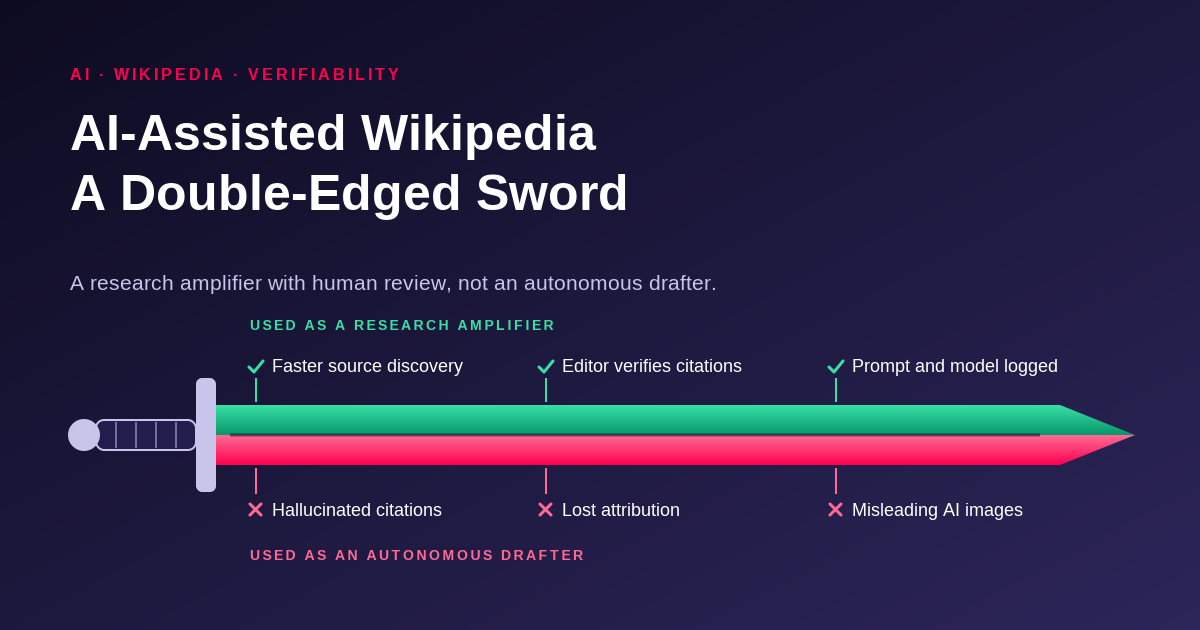
Thesis: AI can improve Wikipedia editing only when it is used as a research amplifier with explicit human review and auditable outputs; used as an autonomous drafting or media generation tool, it undermines the verifiability norms that regulated readers depend on.
The Current State of AI-Assisted Wikipedia Editing
The current practice is uneven and shaped by community norms and new licensing models.
In formal educational programs, participants did not use AI tools to draft text for their assignments [1]. That restraint reflects Wikipedia’s core norm of human attribution and verifiable sources. At the same time, editors are experimenting with AI in the research phase.
Using AI tools in the research stage can be helpful if editors critically evaluate the output [1]. That pattern mirrors how knowledge workers in regulated industries already use GenAI: critical thinking is viewed as cognitive activities performed to ensure the quality of AI responses [2]. In practice that means creating or revising prompts to GenAI tools to get the desired response [2], and evaluating output through response-specific subjective quality standards, such as real-world feasibility or internal logic [2].
On the infrastructure side, the Wikimedia Foundation is formalizing commercial access. The deals mean that most major AI developers have now signed on to the foundation’s Wikimedia Enterprise program [3]. Wikipedia’s content remains freely available under a Creative Commons license, but the Enterprise program charges for faster, higher-volume access to the data [3]. The revenue from these deals helps offset infrastructure costs for the nonprofit, which otherwise relies on small public donations [3].
For banking, healthtech and tax teams, this matters because the training data behind the models they may use internally is increasingly sourced from Wikipedia via licensed feeds, not just scraped mirrors. That creates a governance question: who is responsible when a model surfaces an outdated or contested article?
Benefits of AI-Assisted Wikipedia Editing
When constrained to research support, AI can reduce the cost of finding sources and structuring drafts. The benefit chain is short and auditable:
AI-Assisted Research Generative models can synthesize a literature map, suggest search queries and summarize long sources. For an editor working on a healthtech article about clinical guidelines, that means faster identification of primary sources. The value is contingent on human review, not replacement. Concrete example: an editor drafting a FinTech article on open banking can use an assistant to generate a list of regulator publications and relevant Wikipedia citation templates, then manually verify each link.
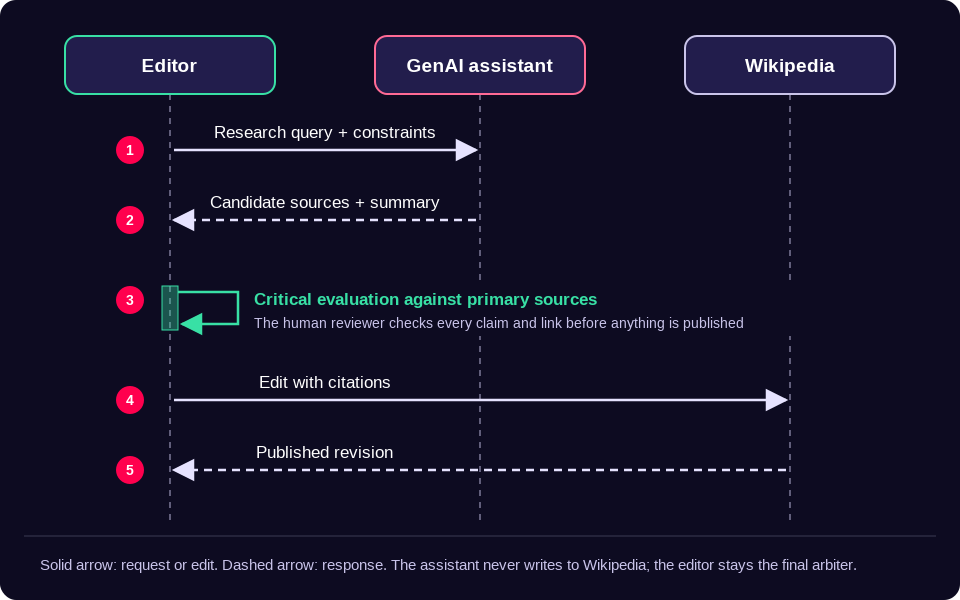
Critical Evaluation Knowledge workers enact critical thinking by creating or revising prompts to GenAI tools to get the desired response [2]. Editors apply the same loop: prompt, review, verify against primary sources. This is where banking and tax domains benefit most: a human reviewer checks regulatory citations rather than trusting a summary.
Improved Content Quality With careful use, research assistance can improve coverage and consistency. Editors can maintain neutral tone and citation density while reducing time spent on mechanical synthesis.
A practical constraint for developers building editing assistants is how models represent structured content. LLMs work based on 'tokens', which are sub-word fragments [4]. Tokens are the units a model predicts; understanding this explains why formatting instructions can be brittle. When generating design or structured edits, systems like IMG.LY serialize designs into a tag-based XML-like format [4]. The LLM can be instructed to return a response in a specific syntax, such as XML-like format [4]. That approach is relevant for tools that propose Wikipedia infobox updates or citation blocks in a machine-readable way.
Challenges of AI-Assisted Wikipedia Editing
The risks cluster around provenance, hallucination and compliance, balanced against the benefits above.
Detection and provenance Pangram correctly identified 100% human-written text from 2015 to the launch of ChatGPT [1]. That historical baseline shows how detection models can be trained, but it does not guarantee future reliability as models evolve. For developers, this means provenance metadata, not detection scores alone, should drive trust decisions.
Image and media risks Generative media introduces new failure modes. OpenAI gpt-image-1.5 was added to the list of generative models for both text-to-image and image editing categories [5]. Evaluation of such models now includes weighted scoring.
A weighted scoring mechanism was added to consider pass/fail, quality, and compliance for a more holistic model evaluation [5]. A compliance score gauge was added to indicate how easily a model can be guided according to a given prompt [5]. A new hand-based anatomy test case was added to the Text-to-Image category to specifically evaluate models' ability to generate accurate hand structures [5].
For HealthTech and Education, using AI-generated images in Wikipedia articles raises liability and accuracy concerns. A misleading anatomical illustration can propagate into clinical training materials. At the same time, compliant, human-reviewed media can improve accessibility.
Policy and trust In Banking, FinTech and Tax Returns, content must be defensible. An AI-assisted edit that cites a hallucinated source can create compliance exposure if the article is later referenced in client-facing material. The norm from educational editing — no participants reported using AI tools to draft text for their assignments [1] — is a useful guardrail for regulated sectors. Balanced against this, formal research-stage use with audit trails can increase transparency rather than reduce it.
Implications for Developers and Content Creators
Developers building editing aids need to design for human-in-the-loop verification, not autonomous publishing. Content creators in regulated industries should treat AI as a research copilot with explicit audit trails.
| Approach | Strength | Risk for regulated sectors |
|---|---|---|
| AI-assisted research + human review | Faster source discovery, consistent structure | Hallucinated citations if review is weak |
| Direct AI drafting | Speed | Loss of attribution, policy violation on Wikipedia |
| AI-generated media | Rich illustration | Accuracy and compliance failures |
Concrete recommendations for developers:
- Log model version, prompt, and timestamp for every suggestion and expose it in the edit summary.
- Require structured output. The tag-based XML-like format keeps the suggestion parseable and auditable [4], and the instruction to return a specific syntax is supported by current LLM prompting practice [4].
- Enforce a human approval gate before any edit is published to Wikipedia.
Concrete recommendations for content creators:
- Version prompts and treat GenAI output as unverified until primary source confirmed.
- Train editors in critical evaluation of GenAI output, as core literacy, not optional skill.
- For Banking and FinTech, review model outputs against regulator source lists; for Education and HealthTech, require subject matter expert sign-off for medical or pedagogical content.
A simple contract for an editing assistant can be expressed as structured output:
<edit-suggestion>
  <section>Tax treatment of digital assets</section>
  <claim>Requires primary source citation</claim>
  <sources>
  <source type="primary" url="..."/>
  </sources>
  <confidence>low</confidence>
</edit-suggestion>
The tag-based XML-like format keeps the suggestion parseable and auditable [4], and the instruction to return a specific syntax is supported by current LLM prompting practice [4].
Conclusion
AI-assisted Wikipedia editing is a double-edged sword. Used as a research amplifier with rigorous critical evaluation, it can improve content quality and efficiency without sacrificing trust. Used as a drafting replacement, it undermines the verifiability norms that make Wikipedia valuable for Banking, Education, HealthTech, FinTech and Tax Returns audiences.
The main points are: community norms currently prohibit AI drafting in education programs [1]; research-stage use is beneficial only with critical evaluation [1][2]; licensing changes are making Wikipedia data more formally available to model builders [3]; and structured, auditable tooling is required to keep human review explicit.
For developers and content creators in those sectors, the prudent path is the same: keep humans as the final arbiter, log the AI contribution, and design tools that make critical evaluation explicit rather than hidden. The technology will keep evolving; the editorial standards that protect readers should not.
Call to action: adopt human-in-the-loop editing assistants with logged prompts, structured XML-like suggestions, and mandatory source verification before any Wikipedia edit is submitted.
References
- Generative AI and Wikipedia editing: What we learned in 2025 – Wiki Education — wikiedu.org
- The Impact of Generative AI on Critical Thinking: Self-Reported Reductions in Cognitive Effort and Confidence Effects From a Survey of Knowledge Workers — microsoft.com (26 March 2025)
- Wikipedia signs major AI firms to new priority data access deals — arstechnica.com (15 January 2026)
- IMG.LY Research: AI-based Generative Design Editing — img.ly (24 July 2024)
- GenAI Image Showdown — genai-showdown.specr.net (28 October 2025)