Agentic AI in Real-World Applications

Benefits of Agentic AI
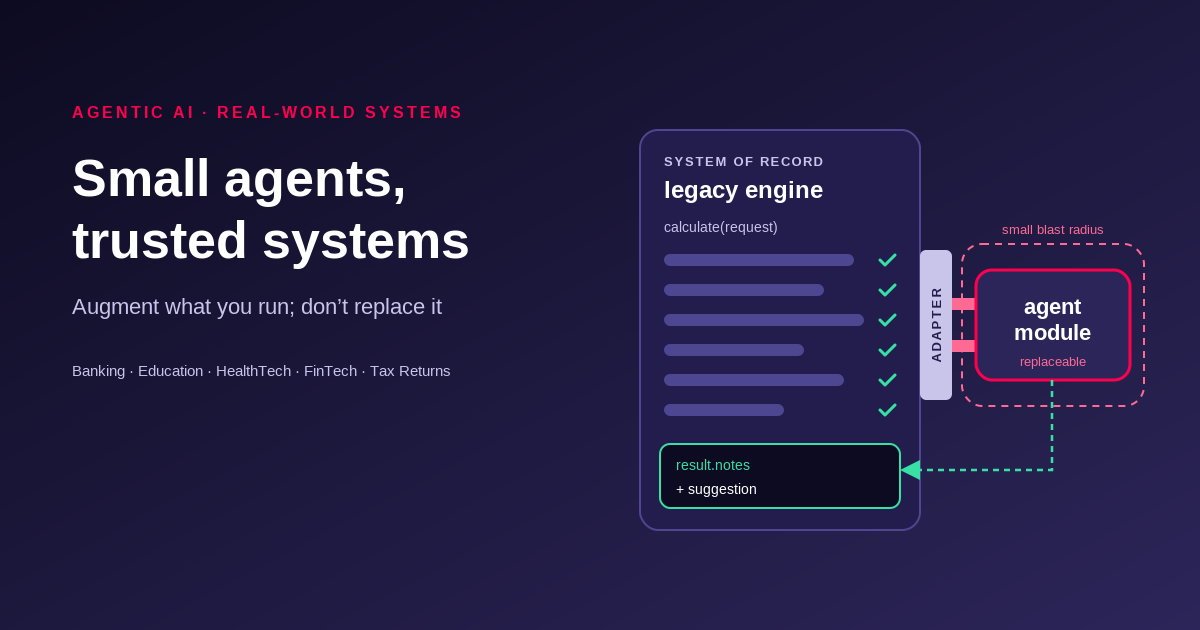
For developers working in Banking, Education, HealthTech, FinTech and Tax Returns, agentic AI is most useful as an augmentation layer rather than a wholesale rewrite.
In HealthTech, the positioning is more sensitive. Founders in Healthcare are downplaying the use of agentic AI in their solutions [1], while in most verticals outside of healthcare the “agentic AI” positioning resonates well provided it meets certain criteria [1].
Across sectors, teams that position themselves as “augmenting” rather than replacing existing employees or legacy tech stacks have found it easier to gain a foothold in large enterprises [1]. That matters for Tax Returns and Education where legacy systems and audit trails are non-negotiable.
Cost visibility is a benefit when agents are run as small, modular services. A sandbox that costs $0.04/hour comes out to roughly $29/month if you keep it running continuously, not including LLM inference, storage, etc [2]. Maritime costs $1 for a 2gb RAM agent per month with unlimited usage for that $1, with additional resources available as needed [2]. These numbers make it feasible to run pilots without committing to a full platform migration.
Challenges and Trade-offs
The biggest trade-off is complexity versus control. Teams often cycle between 4-5 work projects and 2-3 personal projects [3], and adding a new agentic layer can become another project to maintain. As one developer notes, not gonna lie, you don't need to be doing these projects. they're not really worth it [3]. The lesson is to avoid building a full agent platform when a small, scoped assistant will do.
Operational overhead accumulates quickly. There are so many of these small sandbox management tasks that companies have to build and maintain themselves, and they add up [2].
Monitoring, logging, and alerting for agents is itself a product. Observability tools are starting to address this; Laminar’s flow-1 model can analyze every production agent trace without sampling [4], and on their benchmark it matches GPT-6-sol in detection quality while being 23x cheaper [4]. It starts from a compressed string representation of a full agent trace and a user prompt, then greps across spans and reads the relevant ones in full. It returns findings as JSON in a schema users can freely define [4].
Security and compliance are sector specific. Startups that frame agents as augmenting rather than replacing existing employees or legacy tech stacks have found it easier to gain a foothold in large enterprises [1]. For tools you integrate, verify posture: Sonarly is SOC 2 Type II Certified and GDPR compliant [5].
Incorporating Agentic AI into Existing Systems
The fastest way I've seen for builders to get good AI software in the hands of customers is to take small, modular concepts from agent building, and incorporate them into their existing product [6]. That principle holds across Banking, Education, HealthTech, FinTech and Tax Returns.
Around 20 years ago, we started to see DAG orchestrators become popular [6]. The current pattern is less about a central orchestrator and more about embedding small agent capabilities at integration points you already own.
A practical integration pattern:
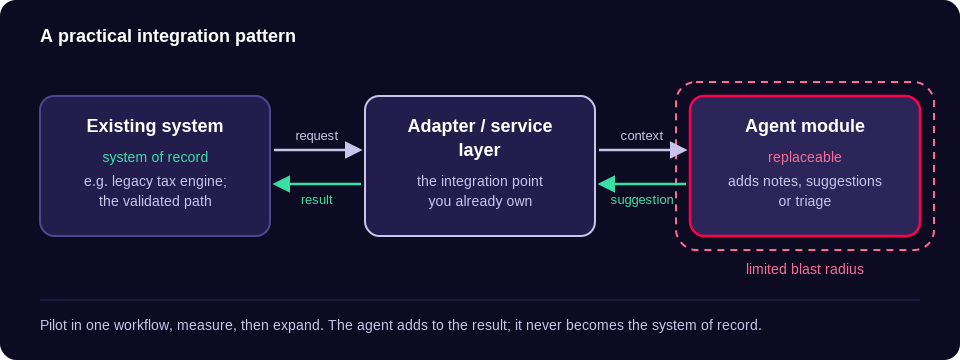
This keeps the agent module replaceable and limits blast radius. You can pilot in one workflow, measure, then expand.
Example code sketch for an augmenting wrapper in a FinTech service:
def process_return_request(request):
  # existing validated path
  result = legacy_tax_engine.calculate(request)
  # small modular augmentation
  if should_suggest(request):
  suggestion = agent_assist.summarize_gaps(request, result)
  result.notes.append(suggestion)
  return result
The agent is not the system of record; the legacy engine is. The agent adds notes, suggestions, or triage.
When comparing integration approaches, the trade-offs are clear.
| Approach | Time to value | Operational risk | Best for |
|---|---|---|---|
| Full agent platform | High | High | Greenfield products |
| Modular augmentation | Low | Low | Banking, Tax Returns, HealthTech |
| Shadow mode pilot | Medium | Low | Education, FinTech compliance |
Real-World Examples and Case Studies
In Banking and FinTech, agents are used for alert triage and duplicate suppression. Sonarly can assign blame, triage severity, and remove duplicates from alerts [5]. On average, 50% of customers' alerts are duplicates. We silence them so your team only sees what matters. Root causes every alert. 84% root-cause accuracy, the best on the market, powered by our codebase graph [5]. Sonarly posts the analysis directly in your Slack or Discord alert channel, in-thread, with the right person blamed. No context switching [5].
In HealthTech, the public positioning is cautious. You know what’s weird? If you use the words ‘agent’ or ‘AI’ it actually backlashes more than it benefits [1]. Teams tend to ship the capability under existing workflow names: “clinical note assistant” rather than “agentic AI”.
In Education, the pattern is similar to Tax Returns: agents summarize student queries, flag at-risk cases, and draft communications for staff review. The agent never writes to the student record without human sign-off.
For developers, tooling matters. The user thefourthchime uses the Claude IDE and has set it to medium skill level [3]. I just use the Claude IDE. I got rid of all my skills and just set it to medium. This reflects a broader preference for integrated, low-friction tools over assembling a custom agent stack.
Best Practices for Implementing Agentic AI
- Start modular. Take small, modular concepts from agent building and incorporate them into their existing product [6]. Do not rebuild the core system.
- Augment, don’t replace. Startups that have positioned themselves as “augmenting” rather than replacing existing employees or legacy tech stacks have found it easier to gain a foothold in large enterprises [1].
- Measure cost per usage. Track sandbox and inference costs. A sandbox that costs $0.04/hour comes out to roughly $29/month if you keep it running continuously, not including LLM inference, storage, etc [2].
- Observe everything. If you run agents in production, analyze every production agent trace without sampling where affordable [4].
- Keep compliance first in regulated sectors. Verify certifications such as SOC 2 Type II and GDPR compliance [5] for any third-party agent component.
The lifecycle for most teams looks like this:
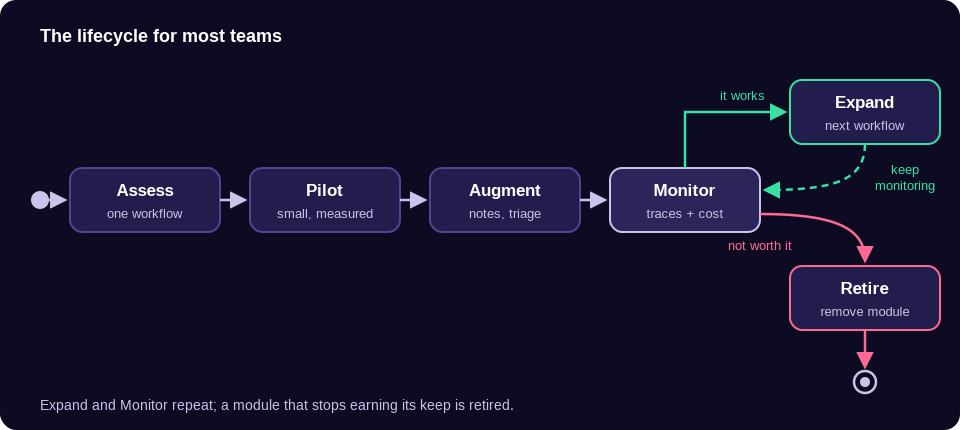
Agentic AI delivers value in Banking, Education, HealthTech, FinTech and Tax Returns when it is treated as a set of small, auditable augmentations to systems you already trust, not as a replacement for them.
References
- State of Agentic AI: Founder’s edition | MMC — mmc.vc (4 November 2025)
- Launch HN: Maritime (YC F26) – A managed cloud for production AI agents | Hacker News — news.ycombinator.com (18 November 2026)
- Ask HN: What's your current AI agentic setup? | Hacker News — news.ycombinator.com
- Launch HN: Laminar (YC S24) – RL-trained model that finds errors in agent traces | Hacker News — news.ycombinator.com (19 October 2026)
- Sonarly - Your software fixes itself — sonarly.com (17 February 2026)
- humanlayer/12-factor-agents — github.com (21 September 2025)